The starting point
Nero's agents can run commands on the computers that operate our cameras, our alarm and our home network. I was not willing to give an AI agent that access without limits, so I wrote rules that restrict what an agent may do, require each action to be reviewed before it happens and require a way to reverse it afterwards.
The change brief
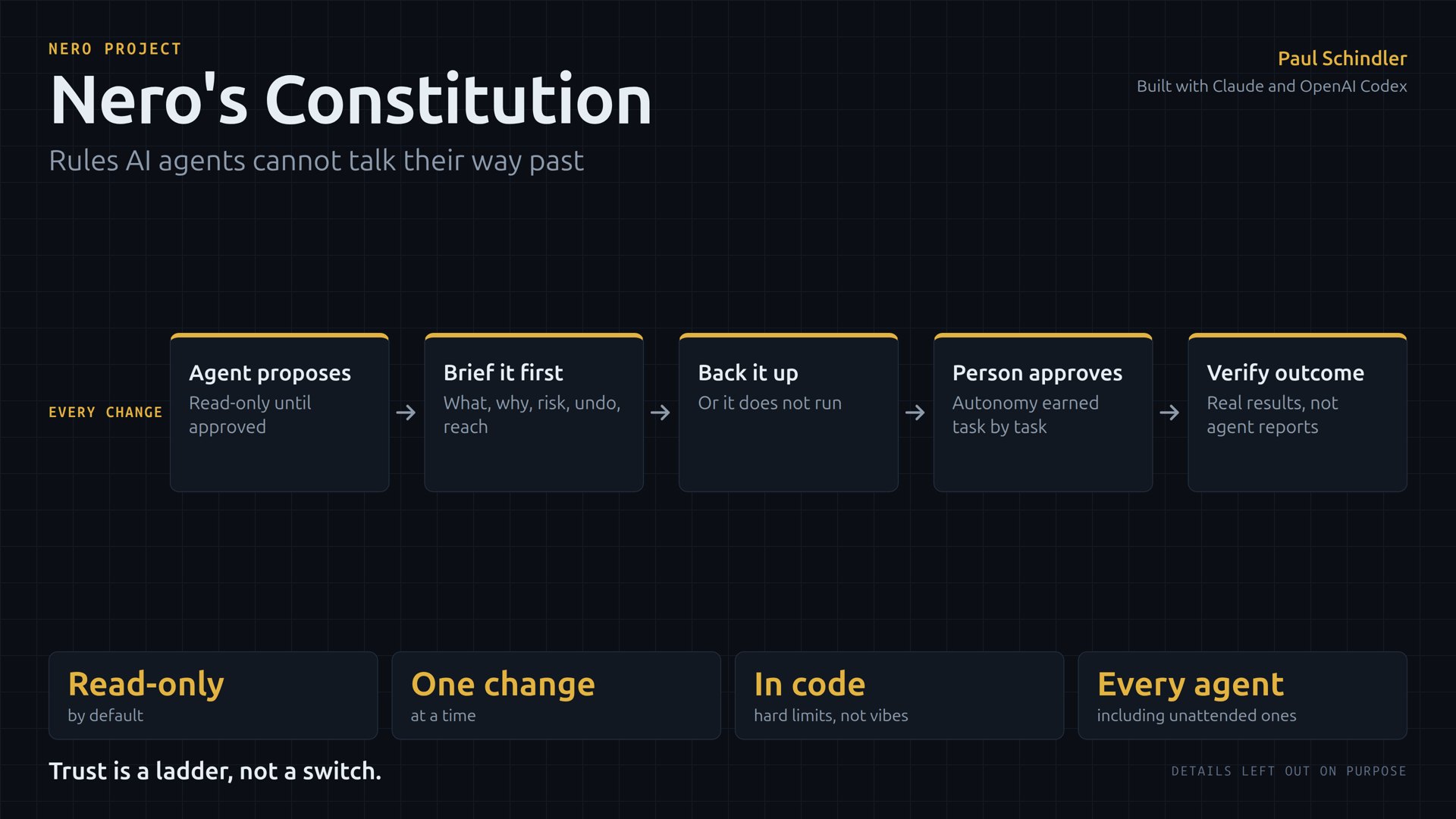
Every agent starts with read-only access. It can read logs, settings, camera events and its own documentation, and it cannot change any of them. When an agent wants to make a change, it writes a brief in plain English with five parts and waits for one of us to approve it.
- WhatThe change, in one sentence that a non-engineer can read.
- WhyThe problem it solves, with evidence.
- RiskWhat could go wrong.
- UndoHow to reverse the change. A backup is made first, and without one the change does not run.
- Blast radiusWhat else is affected while the change runs. A typical entry says that the cameras will pause for thirty seconds.
Changes are made one at a time, and each one is confirmed by its result. I do not accept a report that a command succeeded as confirmation. I check that the doorbell rings or that the recording exists.
AI agents write Nero's code, and my work is to design, specify, review and test it. I approve a change only when I can follow the brief, which is the reason the briefs are written in plain English.
Levels of autonomy
Nero has no general setting that makes an agent autonomous. Permission to act is given by one of us for one type of task at a time, and it is withdrawn the first time a task produces a result we did not expect.
- Level 1Read. Every agent can read everything without asking, at all times.
- Level 2Propose and then act. The agent writes a brief and one of us approves it. The agent then makes that one change and confirms the result.
- Level 3Act unsupervised on small tasks. A short list of low-risk, reversible actions, each of which was added separately.
- ReservedSome actions always need a person. The assistant never disarms the alarm on its own judgment. It disarms only when one of us asks, and separate code decides whether the request is allowed.
Moving a task up a level takes time and a record of good results. Moving it down happens immediately after a single unexpected result.
Enforcement
Rules that exist only in an agent's instructions can be argued around by a capable model, even one that is acting in good faith. For that reason the most important limits are enforced outside the model. Permission settings define the files and commands each agent may use, and a filter blocks destructive commands before they run. The agents cannot edit the settings or the filter.
Records
Nero has two operators, my wife and me. Each working session ends with a handoff note that the other can read, and procedures we work out are written down for reuse. The rules themselves have been reviewed adversarially, as described in case file 07.
"As for the Roman constitution, it had three elements, each of them possessing sovereign powers: and their respective share of power in the whole state had been regulated with such a scrupulous regard to equality and equilibrium..."
PreviousText the HouseNextAn adversarial review of Nero's rules