The problem
On some nights a group of ducks sleeps on the floating dock behind our house, and by morning the dock is covered in droppings. We sometimes launch a kayak from it. Before I looked at any product I set four constraints. The fix had to stay quiet for neighbors across open water, be safe for people and pets, leave the birds unharmed and put nothing permanent in the way.
Five ideas I ruled out
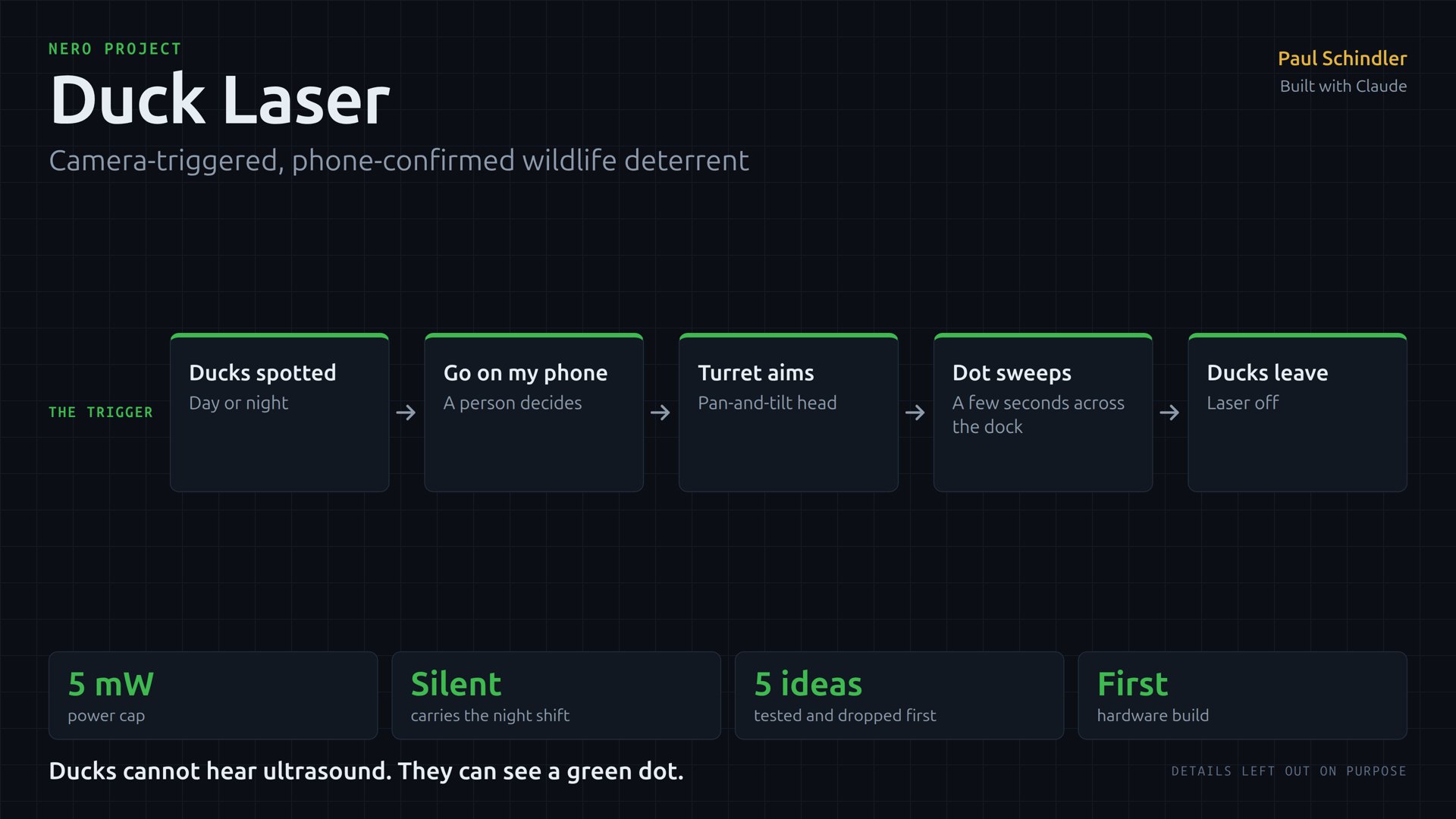
Ultrasonic repellers do not work on ducks, whose hearing tops out at 8 to 10 kHz. Loud audio carries across open water to the homes opposite. A motion-triggered sprinkler grows weeds on the beach, which is a worse chore than the droppings. Lines strung over the dock block the kayak, and a floodlight across the water at night is certain to bother the neighbors.
A low-power laser was the option least noticeable to neighbors. It is silent, it runs for seconds, it lands only on our dock and it works best at night, when the ducks roost. Public wildlife agencies use low-powered lasers to move waterfowl for the same reasons.
The power decision
I considered 8 to 10 mW for daytime use and rejected it. That power crosses into Class 3B, which can injure the retina, including by reflection off water. The problem happens at night and 5 mW covers the night, so the cap stays at 5 mW, Class 3R, the legal limit for laser pointers.
No ready-made unit fit. Consumer bird lasers cost $235 to $590 and sweep patterns across a wide fan on a timer, with no camera trigger. A professional autonomous unit is Class 3B and costs $12,500 to $20,000. I kept the custom build, which has $78 in parts.
How it works
When the camera spots ducks, my phone asks for a go. If I confirm, a pan-and-tilt head sweeps the green dot across the dock for a few seconds and the laser switches off. It fires only on a person's go, and the design has eight independent safeguards, three of them physical.
Getting it approved
A laser near neighbors' homes needed my homeowners association's approval. I built the application around the one objection that could sink it, which was light reflecting off the water, and showed where the beam can and cannot go. The committee approved it 13 days after I filed, in November 2026.
It is my first hardware build. The bench build passed in July 2026, and mounting and camera wiring are next.
"Fortune befriends the bold."