The problem
AI agents can now research, draft, write code and run commands on the computers that run a household. I wanted that help for my household and my projects, which include the systems behind our cameras, our alarm and our home network. I do not write code by hand and cannot judge most code changes line by line, so reading an agent's code was never going to be my control. I had to work out how to give agents real access while a person stays in charge of anything that cannot be undone.
My answer was to write the operating rules before I granted the access. The rules came first, while the agents had nothing dangerous to control, and every later capability was added under them.
What I ruled out
I did not let the agents act freely, because they can run commands on the computers that operate our cameras, alarm and network. I also did not try to approve every code change line by line. I cannot evaluate most code, and approving what I cannot read would have trained me to say yes by reflex. I approve the work and its plain-English brief, and structure in the code limits what an agent can reach.
I did not keep the rules in the agents' instructions alone, because a capable model can argue its way around written instructions. I did not depend on one AI provider either. Bulk research goes to isolated OpenAI Codex workers, and a model on my own hardware takes over the messaging line when the main provider cannot be reached.
How it works
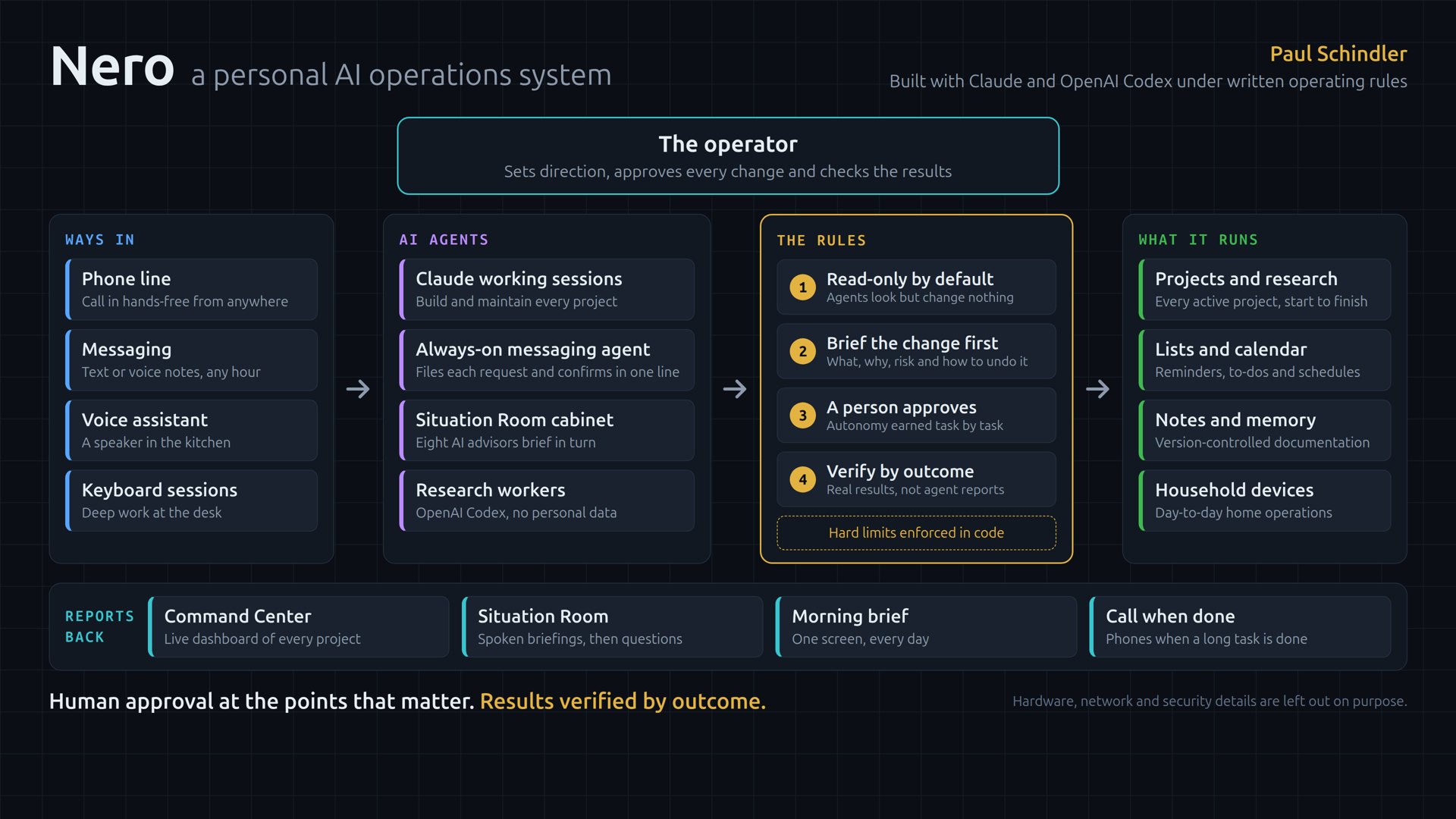
A request reaches Nero in one of four ways. There is a phone line for hands-free calls, a text line for messages and voice notes, voice assistants in three rooms and keyboard sessions for deep work. The voice and text lines share one memory.
An AI agent then takes up the request. Claude working sessions build and maintain each project, an always-on messaging agent files requests, a cabinet of eight AI advisors briefs me aloud and the isolated research workers have no access to personal data. The rules decide what each agent may do before anything changes, and the result comes back to me as a report I can check.
My wife is the second operator. Each working session ends with a handoff note so that the other can pick up the work.
Where it stands
As of November 2026 the system has 1,406 changes recorded in version control, 374 notes in its shared memory and 50+ projects on one live dashboard. The work dates to March 2023 in my notes and early designs, and the current version-controlled system dates from June 2026. The other case files on this site each describe one of its parts.
"Such time, such toil, requir'd the Roman name, such length of labour for so vast a frame."