The problem with store-bought voice assistants
The voice assistants sold for homes can set a timer and read the weather, but they know very little about the household they are in. What they do learn is stored on the manufacturer's servers.
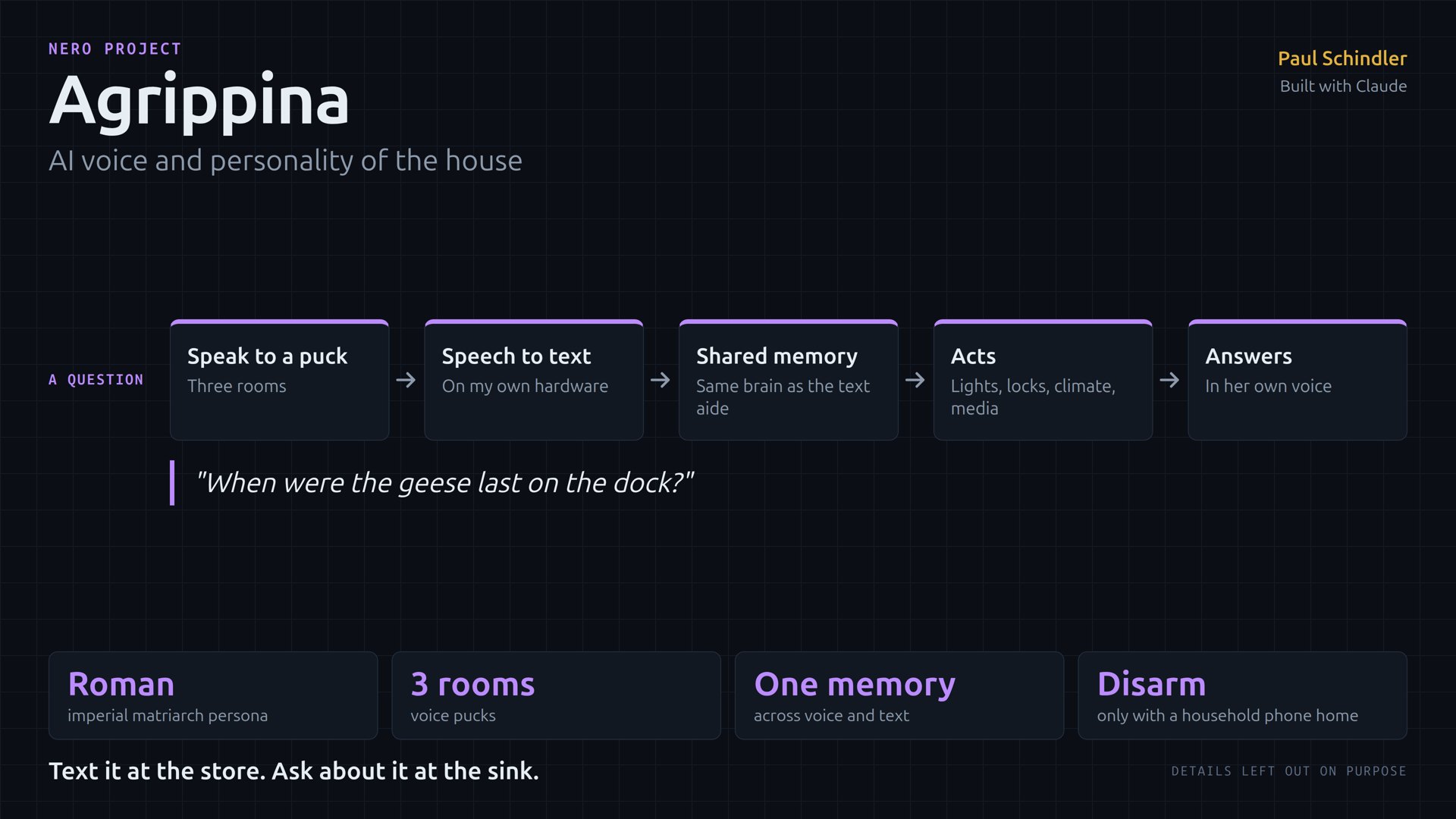
I wanted a voice assistant that knew what the rest of our system knew. So the speaker on the kitchen counter and the text line on my phone are connected to a single assistant, and that assistant has one memory.
How the shared memory is used
If I text the assistant from a store to add milk, the item is on the list that the voice assistant reads back in the kitchen. If I ask aloud for a reminder, the reminder arrives on my phone at the time I gave.
The assistant can also read the log of what our cameras have detected. I can ask it when the geese last visited, for example, and it answers from that log. It writes a briefing every morning and evening on what happened and what is expected, and it can deliver the briefing by voice or by text.
The phone line described in case file 03 works with the same sessions and records.
Limits
Because there is one assistant, one set of limits covers both voice and text. The assistant can do a few small things without asking, such as adding to a list or turning on a light. It never disarms the alarm on its own judgment. It disarms only when one of us asks, and separate code decides whether the request is allowed.
These limits are written down and enforced in code, so they apply in the same way to any new device we connect.
"This active mind, infus'd thro' all the space, unites and mingles with the mighty mass."