The problem
A home camera can record everything and still know nothing. By the middle of 2026 ours had four problems. Cloud camera services analyze footage on their own servers, and even the paid add-on for our camera software uploads snapshots to its vendor to train a model. The vision model ran on the processor of our always-on home server, where each look at a scene took 60 to 120 seconds, and in June 2026 it ran out of memory and shut down twice in 20 minutes.
The camera software also deletes its record of each detection along with the footage within days, so a question such as which animals visit the yard had no data behind it. The last problem was noise. In nine days of September 2026 one camera logged 3,094 car events, and 2,790 of them were parked cars detected again and again.
What I ruled out
I ruled out a cloud camera service and the paid add-on, because both send our pictures out of the house. I ruled out reading license plates with the vision model after a comparison in which none of five models read our own plate correctly, and a dedicated local plate reader does that job. I did not hide busy areas from a camera to cut the noise, because that reduces noise by blinding the system. Repeat sightings are merged into visits.
The first version of the car review asked me to name every car. Of nine cards I answered in one sitting, four mixed up different cars, so I replaced it with filing cars by house. An alert for one look-alike vehicle sent 62 alerts in 25 days and none was confirmed, and I retired it in October 2026.
How it works
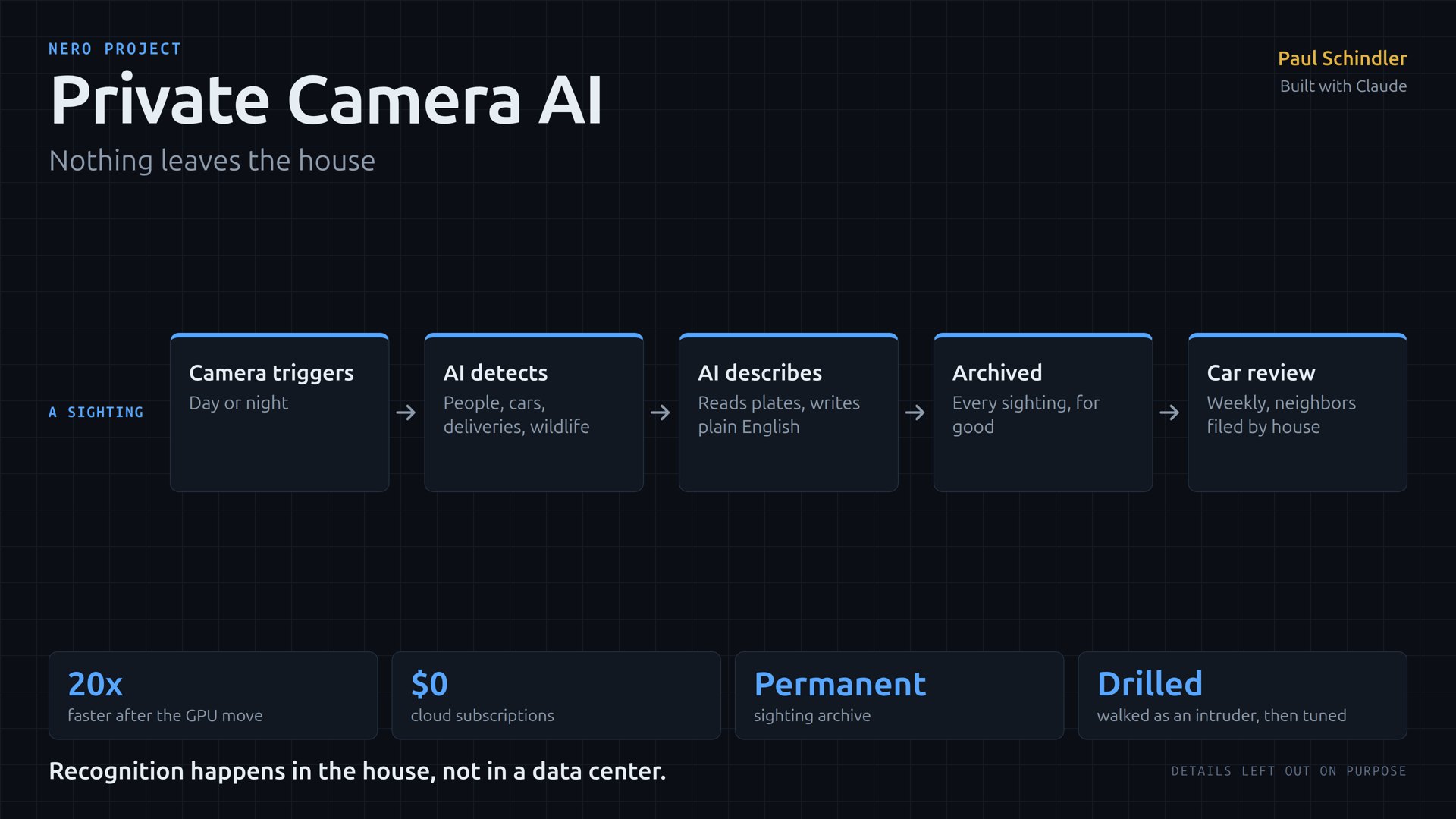
- DetectThe camera software spots a person, car or animal.
- RecognizeA plate reader and face recognition run locally.
- DescribeA vision model on the workstation's graphics card writes one plain-English line, such as a delivery, a visitor or a species.
- ArchiveEvery five minutes each sighting, snapshot, house event and alert is copied into a permanent archive.
- ActA rule decides whether to alert a household phone. A weekly job files cars by house.
Moving the vision model from the home server's processor to a graphics card in the same house made analysis 20 times faster. The agent that reviews the house's setup spotted the mismatch and briefed the move in plain English, and we approved it. I chose the vision model after a comparison on 56 labeled frames.
What stays in the house
Detection, plate reading, face recognition, the descriptions, the archive and the car review all run on equipment we own. Footage and snapshots stay home, and a household phone receives an alert only when a rule decides it should. I also staged an intrusion drill, walking the property as an intruder, and tuned detection from the results. Camera positions and the drill's findings are left out of this account.
"These neither snow nor rain nor heat nor darkness of night prevents from accomplishing each one the task proposed to him, with the very utmost speed."