The problem
An alarm protects a house only while it is armed. Since June 2026 ours could be armed by a text or a tap in an app, but a person still had to remember to do it on the way out. The heating had a related gap. In winter a window left open meant the heat ran against the outdoors until someone noticed.
Automating both is easy to sketch and hard to get right, because a house that guesses wrong does real harm. I started by listing what each kind of mistake costs. Arming while someone is still inside means a siren on our own family, which is the most expensive mistake. Staying disarmed after everyone has left leaves the house as it was before, which I accepted as the safe failure.
What I ruled out
A common pattern arms the house after ten minutes with no indoor motion. Our cats trip the indoor motion sensors, so motion never arms or triggers our alarm. I also ruled out tracking where we are. My privacy rule is that the house may know only whether we are home or away and never where we are, so a door opening became the sign that someone had left.
The house does not arm when the first person leaves, because one stale reading would arm it on whoever is still inside. Arming needs everyone to read away, and disarming needs only one arrival. It also does not restart the heat whenever the windows close, because that would override anyone who had switched the heat off by hand. The house undoes only what it did itself.
How it decides
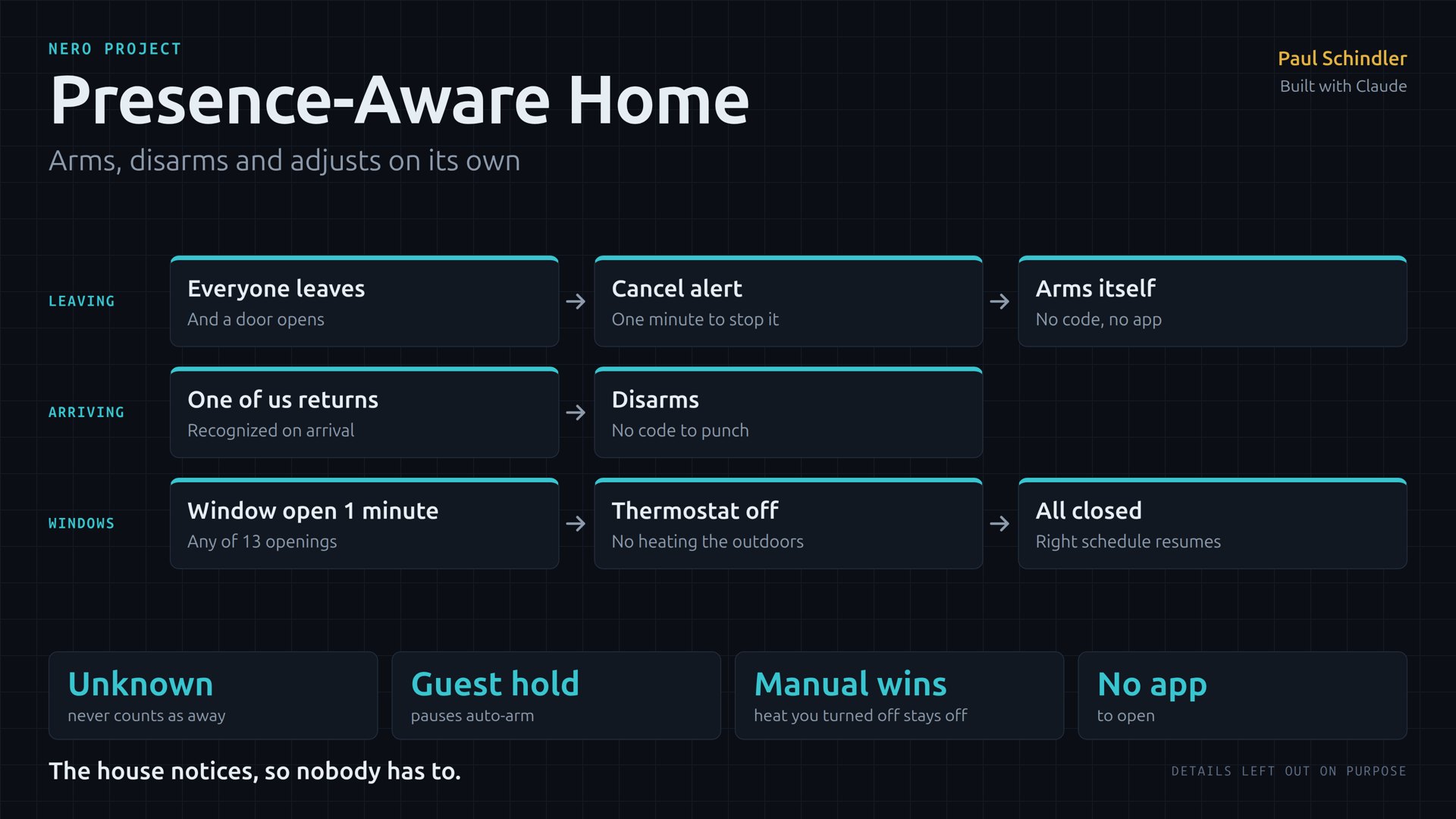
The house arms itself when everyone has left and a door has opened, after a one-minute alert on our phones that either of us can cancel. It checks every condition again before it arms, and it reports what it did in one line. It disarms when one of us comes home. A guest hold pauses auto-arming while visitors are in the house, and it clears the next time one of us returns.
The thermostat turns off when any window or outside door stays open for a minute and returns to the right schedule once all 13 are closed.
Safeguards
An unknown reading never counts as away. A sensor that stops reporting is treated as no signal after 170 minutes, and a daily alert names it, so that one dead battery cannot hold the heat off for good. Every failure I have found ends in the house not arming or in one of us disarming by hand, and none ends with the house arming on people inside. Arming and disarming by text, app or voice all still work.
This account describes what the house decides and why. It leaves out which signals the house uses to recognize us.
"There is nothing dearer to a man than his own country and his parents."