Why I had the rules reviewed
Nero's agents work under written rules that my wife and I developed over many sessions and keep in version control. By July 2026 those agents could change home-automation settings and run unattended overnight. We had written the rules ourselves, and I thought it likely that we were too familiar with them to see where they were weak. The system had also grown for a month after the rules took effect, and nobody had compared its permissions with the rulebook.
How the reviews were run
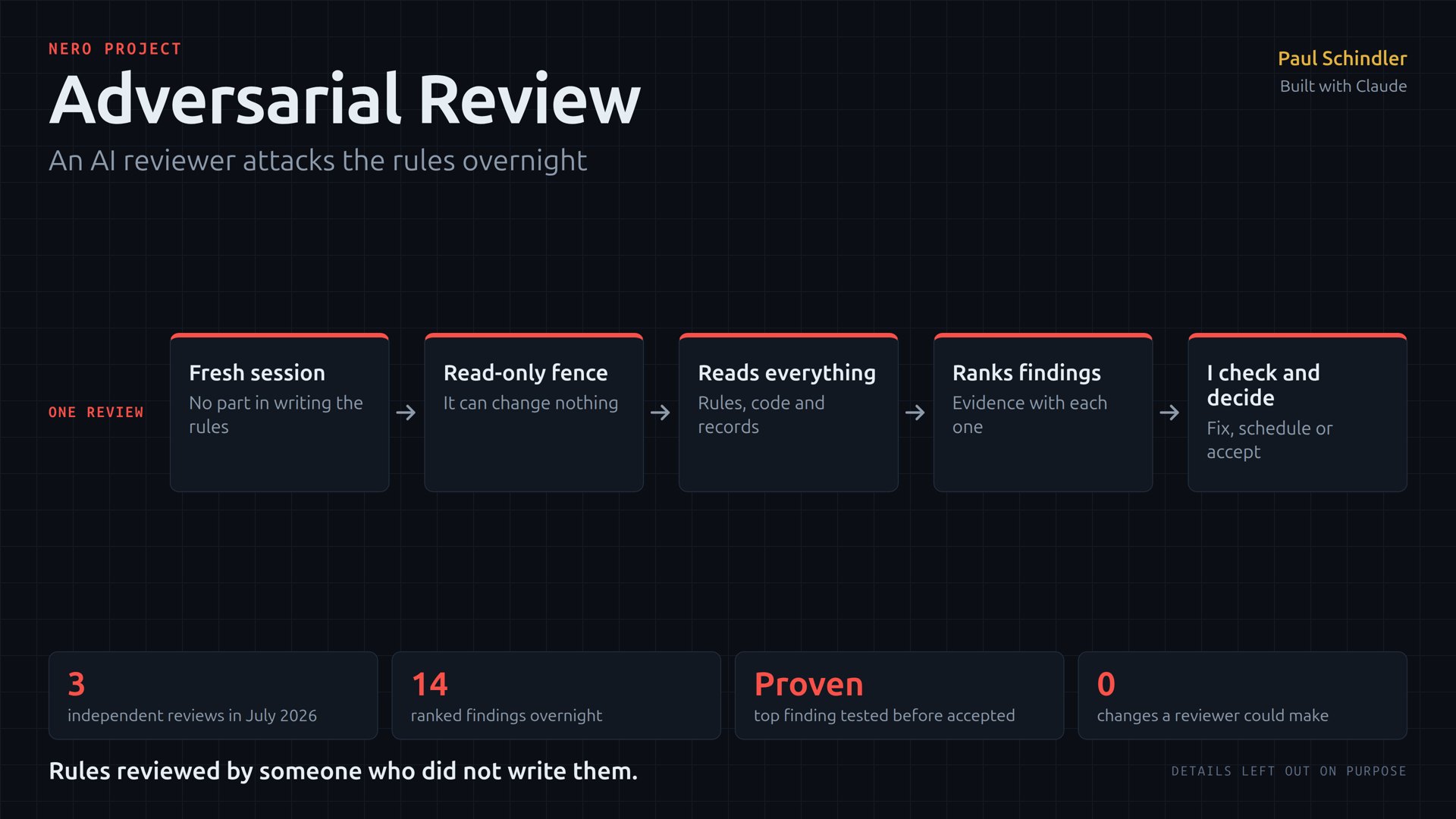
Each review began in a new session that held no record of how the rules had been written. Its instructions were to find the places where the rules fail, promise more than they deliver or describe a protection that does not exist. Every reviewer had to name the file behind each claim and close its report with a list of what it could not verify. None of them could change anything.
- July 1A reviewer on first contact with the system read all 224 tracked files and returned 12 ranked findings.
- July 4The overnight review ran in an isolated folder with no one watching and returned 14 ranked findings.
- July 9An operations review used six read-only reader agents to examine which agents can act and how much reaches me for approval.
The overnight run did not go smoothly. Two hours in, the judging model's safety system began refusing to continue, because the notes it had gathered were dense with home-security detail. The run switched to the fallback model I had named in advance, which finished the report from the written notes in one 16-minute pass.
What they found
The most serious finding concerned the agent that answers our messages and voice requests around the clock. The rules gave it a short list of named actions. It ran in the same folder as my keyboard sessions, so it also loaded every permission I had approved there during ordinary work. I tested the claim before I accepted it. In a test session launched with a short allowed list, a command permitted only in the shared file ran without a prompt.
I changed the agent's launch settings to name specific commands and to refuse the most dangerous inherited ones. A second finding was that the rule against disarming the alarm by voice existed only as an instruction to the model. Code now decides, and voice disarm works only when the code confirms that a household phone is home.
The reviews also found that a measure I had been using to judge how much an agent could be trusted was never kept. Each procedure carried a count of clean runs, and nothing updated it. A high count had been giving me an impression of safety without any evidence of it. I removed the counter on July 4, and a person now assigns each procedure a trust level from observed results.
What happened to the findings
The July findings went into one ledger with those of a June self-review and a September audit by a reviewer from a second AI provider. The ledger holds 239 findings, and I gave each one a written decision in September 2026. At the October 2026 recount 205 were settled, 23 had moved to other workstreams and 11 were still open. Some I accepted instead of fixing, each with a recorded reason.
Testing the reviewers
Before I accepted the verdicts of one review agent, I gave it five test notes. Four carried errors I had planted and one was clean. It caught all four and passed the clean one.
Review agents are also not shown the reasoning behind the proposals they review. A high-stakes proposal goes to an agent that receives only the claims and the supporting data, because a reviewer that has read the argument for a proposal tends to agree with it.
"In most cases men willingly believe what they wish."